• About

anactofmind

~ If there is anything in the world that can really be called a man's property, it is surely that which is the result of his mental activity. – Arthur Schopenhauer

anactofmind

Category Archives: Roman Catholicism

Can Roman Catholics Change Their Name?

25 Friday Oct 2013

Posted by Paul Bassett in Papacy, Roman Catholicism

≈ Leave a comment

Recently a Roman Catholic ecquaintance of mine wrote here about his dissatisfaction with the first part of his denomination’s name, i.e. “Roman”.    It seems that the geographic label is used against him in his apologetic interactions with Protestants.  And my friend is rather tired of being “beat ‘round the ears” with the label and so is justifying his cessation of its use.

I understand the nature of his objection to be:

  1. “Roman” is just part of what he calls “modern nomenclature” and is therefore not important.
  2. If he can describe himself as a “Christian” he may be absolved from using “Roman” in his self-description.
  3. Membership in a local parish or diocese is all that is necessary to be Catholic.
  4. There is only one diocese in the world that can accurately be described as “Roman Catholic”.

To begin, we must assert the official dogmatic position of the Roman Church with regard to its nature.  According to Roman dogma,

The Church is a society instituted by Christ God…; a people one in faith, end, and things conducing to that end; subject to one and the same power, a society divine in origin…  It is a society perfect and independent…; an immutable organization…with the right to possess even temporal things…and with temporal power…it is one (in faith, rule, and communion…) and unique…, holy… catholic… apostolic… which is Roman….” etc.[i]

So we see here, at the outset, that the descriptor “Roman” is as important to Catholic self-description as being “instituted by Christ God”.  And likewise, it is not something capriciously to be discarded.

In fact, it is an intricate part of “Tradition” so that Denzinger traces the formality of the use of “Roman Catholic” through the last 800 years of Church History.

One example from the Council of Lyon (1274) may be cited:

Also this same holy Roman Church holds the highest and complete primacy and spiritual power over the universal Catholic Church which she truly and humbly recognizes herself to have received with fullness of power form the Lord Himself in Blessed Peter, the chief or head of the Apostles whose successor is the Roman Pontiff.[ii]

And this idea of “complete primacy” was extended later to the Bishop of Rome.  Here is Vatican I:

Wherefore we teach and declare that, by divine ordinance,the Roman church possesses a pre-eminence of ordinary power over every other church, and that this jurisdictional power of the Roman pontiff is both episcopal and immediate.

Both clergy and faithful, of whatever rite and dignity, both singly and collectively, are bound to submit to this power by the duty of hierarchical subordination and true obedience, and this not only in matters concerning faith and morals, but also in those which regard the discipline and government of the church throughout the world.[iii]

In sum, being a “Roman” Catholic is not just nomenclature – it is dogma.  And being Roman Catholic means that one is primarily a member of the “Roman” church and secondarily a member of a local diocese and parish.  Further, being a Roman Catholic means acknowledging that the Pope of Rome has a “primacy of jurisdiction” over you and that that primacy is both “ordinary” and “episcopal”.  In other words, a Roman Catholic owes his first allegiance to the Bishop of Rome and secondarily to his local “ordinary”.  Those are the rules set out by Rome and it therefore is of no consequence how one local parishioner thinks he can change his name.

I firmly believe that if good, well-meaning Catholics like my equaintance want to become Roman Catholics, then we have a duty to help them understand the magnitude of their decision.

They are not free to change their name, no matter how much that puts them out.

Soli Deo Gloria.


[i] Denzinger, Henry.  The Sources of Catholic Dogma.  Trans. Roy J. Deferrari from the Thirtieth Edition of Henry Denzinger’s Enchiridion Symbolorum.  New York. Preserving Christian Publications, 2009.  Systematic Index Iia.  Nihil Obstat: Dominic Hughes, O.P.  Imprimatur:  Patrick A. O’Boyle, Archsbishop of Washington.

[ii] Denzinger, op. cit.  460, 466.

[iii] Decrees of the First Vatican Council, Session 4, Chapter 3: On the power and character of the primacy of the Roman pontff.  http://www.papalencyclicals.net/Councils/ecum20.htm#Chapter 3. On the power and character of the primacy of the Roman pontiff

A Book Review: Why Catholicism Matters by William Donohue

07 Sunday Jul 2013

Posted by Paul Bassett in Religious Freedom, Roman Catholicism, William Donohue

≈ Leave a comment

Tags

Catholicism, Donohue

Whenever you see Bill Donohue’s name you can be sure that whatever follows is a vigorous defense of Roman Catholicism –  and his new work, “Why Catholicism Matters” is true to form.   But Catholics would be ill-advised to use Donohue’s presentation as part of their own defense simply because it is so poor.  Donohue lets his Catholic friends down by engaging in what can only be described as intellectual sleight-of-hand and by misrepresenting the history and teachings of his denomination in ways that would make any honest scholar blush.

Donohue begins his work by crediting the Catholic Church with everything from creating the university, art, architecture and music.  He says that “were it not for several popes who intervened against those who sought to deny academic freedom, the course of learning in the time to come would have been stifled.” (Page 5)  But what he is apparently unaware of is that these universities effectively replaced the local bishops as the source of doctrine – and the concept of the bishop is central to Catholicism.    But a true scholar has this to say of the effect of the creation of the university upon society and the Church:

“In the thirteenth century the schoolman replaced the bishop and the abbot as the typical exponent of doctrine…What had happened was that the masters had emerged alongside the bishops and the abbots as formative influences in the life of the church.  As a source of doctrine, they had indeed superseded them.”  (Professor Colin Ferguson, “The Papal Monarchy:  The Western Church from 1050 to 1250”; Oxford, 1989.  p. 507)

So Donohue is unwilling or unable to interact with this fact – that the university whose creation he credits to the Church of Rome became an extra-ecclesial body which replaced the bishops as a source of doctrine.  Given Rome’s doctrine of the Magisterium this would seem then to be not such a good thing!

And what, exactly, was taught in these universities?  According to Donohue, “Students learned from Aristotle and Cicero, drawing on their philosophical genius as bedrock for Christian thought.” (p. 5).   So Donohue’s idea of the Catholic contribution to education is that Rome built the universities, not on Christian thinkers or the teachings of Christ, but on two pagans who never even heard of Jesus Christ.
Today’s leading scholar of the Reformation, Professor Diarmaid MacCulloch shows how deadly this conflation of paganism and Christianity actually is as it was applied as dogma by the Catholic Church:

“From the fourteenth century, most philosophers and theologians, particularly in Northern Europe, did not in fact believe this [i.e. the doctrine of transubstantiation]  They were nominalists who rejected Aristotle’s categories…it [transubstantiation] ought not be approached through the Thomist paths of reason, but most be accepted as  a matter of faith…Those who remained in the Roman obedience generally did this; but in sixteenth-century Europe, thousands of Protestants were burnt at the stake for denying an idea of Aristotle, who had never heard of Jesus Christ.”  (Diarmaid MacCulloch.  “The Reformation.”  Penguin Books, New York; 2003.  p. 26)

But Donohue’s admiration for both Aristotle and Aquinas puts him in a very difficult spot later in his book.  On page 84 he makes this unsupportable declaration: “The Catholic Church has never had to switch gears; it has never been anything but pro-life.”  (And by pro-life he means the belief that life begins at conception.)  But neither Aristotle nor Aquinas was pro-life in that sense.  Aristotle taught a doctrine of “delayed ensoulment” and Aquinas, because he was an Aristotelian, taught a similar doctrine.   Add to this the fact that as a “Doctor of the Church” the works of Aquinas have been declared free from defect or error by Rome.  Does Mr. Donohue have the gravitas to supplant those credentials or is he just wrong?

In addition to these rather egregious philosophical and theological errors, Mr. Donohue makes an excessive number of historical mistakes such that they cannot all be dealt with here.  The most offensive is his attempt to piggy-back Catholicism on the backs of America’s founding when this country was clearly an escape from the Catholic totalitarian states of Europe.  Where he does note that less than 1% of the colonists at the time of our founding were Roman Catholics he fails to deal with the fact that America’s Founders were opposed to Catholicism precisely because it historically led to despotism and not the republican principles the Founders espoused.

Dr. Brion McLanahan documents the sentiments of the Founders this way:

“Amos Singletary said in the Massachusetts Ratifying Convention that he was troubled that “there was no provision that men in power should have any religion; and though he hoped to see Christians, yet by the Constitution, a Papist, or an Infidel, was as eligible as they . . . in this instance, we were giving great power to we know not whom.”  (The Founding Fathers Guide to the Constitution. Regnery Publishing, 2012.  Kindle Location 2700-2703)

The Founding Fathers were overwhelmingly Calvinist so the idea that Roman Catholicism had a role in America’s founding is simply untenable.

But the error that is by far the most blatant and deserves to be discredited in the most forceful terms is Donohue’s treatment of Nazism.

Mr. Donohue takes credit for the Catholic Church in the verdicts rendered at the Nuremberg trial of the Nazis:  “Thus the Catholic natural law tradition was vindicated.” (p. 50).  What Donohue obfuscates or ignores was that the Nazis WERE Catholics.  Hitler himself came from Catholic parents and was baptized and confirmed in the Roman communion.  And, likewise his most influential lieutenants!  Later in the text, Donohue goes completely off the reservation when he describes Hitler as an “atheist”.  Apparently it’s an inconvenient truth that once someone is baptized into the Catholic faith, unless they make a specific request outlined in the Canon Law to be witnessed by two deacons, they are forever a Catholic.  Hitler was a Catholic – period.

But more damning for Mr. Donohue and his cause is the influence that Catholicism had on Hitler and the Nazis.  The question has to be asked, where did the Nazis get the idea to put Jews in “ghettos” and concentration camps?  And the only answer is that they got that idea from the Roman Catholic Church.  We now know with absolute certainty that the Church of Rome imprisoned Jews in ghettos throughout the Papal States for 700 years!  That is exactly where Hitler got the idea for the camps!  And the follow-on question, which is equally as tantalizing – is why were ALL the Nazi death camps in Poland the only European country not touched by the Reformation and whose population is entirely Catholic??

And Donohue’s abuse of the record with regard to Nazism leads inevitably to his errant, one-sided defense of Pius XII.  What must always be kept in mind in this discussion is that Pius XII (as Eugenio Pacelli) negotiated the Reichskonkordat with the Nazi’s that gave them their initial prestige.  This was a Catholic-to-Catholic negotiation because Pacelli conducted his negotiations with Franz von Papen who Hitler’s biographer, Ian Kershaw described as “an urbane and well­connected member of the Catholic nobility.” (Kershaw, Ian. Hitler: a biography. London:  W. W. Norton & Company, Ltd., 2008.  P. 230.  The effect of this concordat was to silence the German episcopacy and forbid it to publicly comment on politics.  So Pacelli (later Pius XII) was the one who lent the prestige of the Vatican to the young Nazis which propelled them to power. To suggest that as pope, Pius would go back on his previous commitments leads to the conclusion that he was not a man of his word, or worse.

A couple of the more humorous errors you can look for in this book are that Gregory of Nyssa was the pope (he was not) and that Galileo was an “astrologer”.   (That last one provided a much needed laugh for which I am grateful!)

If Catholicism needs a defense, this is not it.  And if Catholicism needs a defender Donohue is not him.  If you are interested in defending the Catholic Church, I beg you not to use any information in this book.  You will only serve to embarrass yourself and hurt the cause.

To God alone be the glory!

The Death of Roman Catholic Tradition

11 Saturday May 2013

Posted by Paul Bassett in Charles Chaput, Garry Wills, Religious Freedom, Roman Catholicism

≈ 4 Comments

It is certainly no secret that that Catholic Church has taken it on the chin from Obamacare and the Health and Human Services Administration (HHS).  The HHS has mandated that Roman Catholic employers must provide insurance which pays for abortifacient drugs for the people they employ.  But the Roman Catholic Church is opposed to abortion, at least the modern Roman Catholic Church is.[i]  That has caused the RCC in the United States to complain that its religious liberty has been infringed.  And that infringement was the occasion for a recent address by the Most Reverend Charles Chaput, Archbishop of Philadelphia to a group in Greensburg, PA.  What I found fascinating about the Archbishop’s address is that he while he admonishes his audience to remain true to their Catholic heritage he does so on a Protestant foundation.  In other words, he had to abandon Catholic teaching and Tradition on the issue of religious liberty and build his case on the work of the Protestant Founders of America.

His Excellency encouraged his audience not to “dilute our zeal as Catholics” and reminded them that they cannot “achieve good ends with impure means”.[ii]   He reminded his hearers of his work on the United States Commission on International Freedom which taught him “importance of religious liberty both abroad and in our own country.”  The Archbishop then stated that the (charitable) work of the Catholic Church must be ordered by certain principles, the first of which is this:

First, all Catholic social work should be faithful to the mission and structures of the local diocese, with special respect for the role of the bishop. It should be true to Scripture, Church teaching and the Code of Canon Law.[iii]

And that this liberty to practice one’s own religion is one of the “cornerstones of the American experience.”  The Archbishop then cites “James Madison, John Adams, Charles Carroll, John Jay, George Washington, Alexander Hamilton, Benjamin Franklin, Thomas Jefferson” as examples of men who shared his view on religious liberty.  It is interesting to me that all of these men, with the exception of Charles Carroll were Protestants.

But if we are to take the Archbishop’s admonition to remain “true” to “Church teaching” we must ask what was the Catholic Church’s teaching during the period of America’s founding down to modern times.  And that is where things become very interesting because the Roman Church has historically been against the very same “religious liberty” that the Archbishop now sees as so important to his cause.

Official “Church Teaching” on Religious Liberty: 1776-1958

Because the Archbishop ties his understanding of religious liberty to America in the eighteenth century it seems only fair that we examine what the Roman Church taught during the period.  At the time of the American Revolution of 1776 and through the period where the U.S. Constitution was drafted, ratified and implemented, the pope of Rome was Pius VI.  Here is an example of Pius VI’s idea of “religious liberty” in the Papal States over which he presided:

…at the time of Pius VI came to St. Peter’s throne in 1775 and issued his order reinstating all the old restrictions, Jews lived in eight ghettoes, locked in each night behind high walls and heavy gates. Everyone was able to tell who was a Jew, because, in another sixteenth-century papal provision reiterated in the 1775 edict, Jews were required to wear a special badge on their clothes…Jews were not allowed to keep shops or warehouses outside the ghetto and their social isolation was to be strictly enforced.[iv]

If you were a Jew living in Rome at the time of the American Revolution, “religious liberty” meant being imprisoned, giving up your possessions and being harassed by the Catholic Church.

The pontificate of the next pope, Pius VII was marked by the struggle with Napoleon.  It is interesting that Napoleon freed the Jews imprisoned by the Catholic Church after he invaded Rome at the beginning of the 19th century.  Unfortunately the Jews were re-imprisoned by the next pope, Leo XII in 1826.  One notable Catholic historian describes Leo this way:

Leo XII’s pontificate was an extremely conservative one:  he condemned religious toleration, reinforced the Index of Forbidden Books and the Holy Office (formerly the Inquisition), reestablished the feudal aristocracy in the Papal States, and confined the Jews once again to ghettos.[v]

Leo was followed by Pius VIII who lasted only twenty months who was in turn followed by Gregory XVI.  And Gregory was no fan of “religious liberty”.  Fr. McBrien once again:

Gregory XVI was as rigid in dealing with theological issues as he was in dealing with political ones.   In his encyclical “Mirari vos” (August 15, 1832)…he denounced the concepts of freedom of conscience, freedom of the press, and separation of Church and state, particularly the liberal views associate with the French priest Félicité Robert de Lamennais…(Lamennais favored religious liberty and the separation of Church and state….[vi]

The last pope of the 19th century was Pius IX.  Pius was famous for, among other things, his Syllabus of Errors.  That document listed a variety of doctrines or viewpoints that, if applied to the Roman Catholic Church would be considered errors.  And religious liberty would be included in that list of errors.  Here is the way Pius IX phrased it:

That in the present day, it is no longer necessary that the Catholic Church be held as the only religion of the State, to the exclusion of all other modes of worship: whence it has been wisely provided by the law, in some countries nominally Catholic, that persons coming to reside therein shall enjoy the free exercise of their own worship…That the Roman Pontiff can, and ought to, reconcile himself to, and agree with, progress, liberalism, and modern civilization.[vii]

The next pope was Leo XIII.  And the irony of Leo’s papacy in light of Archbishop Chaput’s presentation is that Leo disliked the American system so vehemently that he created the heresy of “Americanism”!  In his encyclical “Longiqua Oceani” the pope put the matter this way:

…it would be very erroneous to draw the conclusion that in America is to be sought the type of the most desirable status of the Church, or that it would be universally lawful or expedient for State and Church to be, as in America, dissevered and divorced.[viii]

You see, according to the Pope, the type of system the Archbishop thinks is fundamental to defend the religious liberty of Catholics is actually heretical.  If the Archbishop were true to his own dictate to remain true to “Church teaching” he would give up this talk of liberty.

And the next pontiff – the “pastoral” Pius X – was no different.  It seems that this pope was so set against “religious liberty” that he refused to see the American President Teddy Roosevelt simply because the President was scheduled to speak at a Methodist Church in Rome.  I have a hard time finding the “liberty” in that story, don’t you?

Benedict XV’s pontificate seems to have been preoccupied with internecine quarrels as well as with the events of the First World War.   But his successor, Pius XI renewed Rome’s march against religious liberty with the encyclical “Martalium animos” which “forbade any Catholic involvement in ecumenical conferences.”[ix]

The last pope that I will mention brings us past the mid-point of the twentieth century; Pius XII.  And I have to note him with a truly great sense of irony.  You see, Pius XII instigated a “persecution” of leading Catholic scholars of the day including Henri de Lubac, who Archbishop Chaput quotes from to begin his speech!  And while it is true that John Paul II later raised de Lubac to the episcopate, the fact remains that he was first an example of the sort of religious intolerance which is the true legacy of Rome.

Conclusion:

The Tradition of the Roman Catholic Church is to deny religious liberty.  That case has been made by a review of centuries of official Catholic documents promulgated by every pope from America’s founding until the mid-twentieth century. It is beyond question that Rome’s official position is one in opposition to “liberty”.  And that the American system of which Archbishop Chaput thinks is so instructive has actually been declared a heresy by Rome.

In order for this not to be true, it will be necessary for Roman Catholics to show where, when and by whom these many papal pronouncements have been rescinded, reformed or replaced.  A feat that cannot be accomplished given the nature of papal writings.

Therefore we must conclude that either the Tradition of Rome is dead or that the venerable Archbishop of Philadelphia is a heretic.  As harsh as that may sound, what other choice is there?

Soli Deo Gloria.


[i] It is an interesting fact of history that the Roman Catholic Church has not been opposed to abortion until recent times.  You can read more about that here .

[ii] It seems to this writer that God Himself has achieved good ends almost entirely through “impure means” if the Scriptures are any testimony.  The only exception I can recall are the ends that God achieved through Christ who is, of course, pure.

[iii] http://bit.ly/11LNsNg

[iv] Kertzer, David I.  The Popes Against the Jews: The Vatican’s Role in the Rise of Modern Anti-Semitism.  New York:  Alfred A. Knopf, 2001.  Pgs. 28-29.

[v] McBrien, Richard P.  Lives of the Popes.  San Francisco: HarperCollins Publishers, 1997.  Page 333.

[vi] Ibid. p. 338

[vii] http://www.papalencyclicals.net/Pius09/p9syll.htm

[viii] http://www.vatican.va/holy_father/leo_xiii/encyclicals/documents/hf_l-xiii_enc_06011895_longinqua_en.html

[ix] McBrien, p. 360.

How Catholics are supposed to interpret the Scriptures.

14 Sunday Apr 2013

Posted by Paul Bassett in Hermeneutics, Matthew 16, Roman Catholicism, Trent

≈ 13 Comments

In a recent exchange I had with Joseph Richardson (which can be found here ) I was surprised to learn that Joseph was unaware of the rules the Catholic Church maintains about the proper use of the Scriptures. My point to Joseph then was that he was using Scriptures like a Protestant. He was surprised by that comment and responded this way:

First: What makes you say, “Roman Catholics are not allowed to offer their own interpretations of Scripture”? Is being Catholic somehow a handicap to my powers of reasoning? What makes Protestants able to offer their own interpretations of Scripture, and Catholics unable? Because this is in fact my own interpretation, based in a careful study of the Greek, of the whole of Scripture, not just the passage you are drawing attention to, and of the teachings of the Fathers.

So to make the case clear how Catholics are bound to use the Scriptures and to answer Joseph’s questions I will explain the Catholic requirements for using the Scriptures. This explanation will come exclusively from Catholic sources and are noted for easy verification. I would like to point out at the beginning that all of the sources used in the post are “dogmatic” for Catholics. That means that the information we will explore is not “optional” for Catholics to believe; it is required.

The first thing we have to do is discover the Roman Catholic understanding of divine revelation. That is important because Rome takes a different view than the rest of Christianity and because Rome binds the consciences of her members to that view. That is to say, to be a Roman Catholic means that you affirm this view, without reservation. The second thing we have to do is understand the role of the Magisterium in the interpretation of the Scriptures for the Catholic faithful: what is its role and what are Catholics required to believe. Finally, we will outline how Catholics are, based on this information, supposed to interpret the Bible.

Roman Catholic Revelation – the three legged stool.

Roman Catholicism has a unique doctrine of divine revelation. And the Tradition of Roman Catholicism – dating at least back to the Council of Trent – is that divine revelation to a Catholic comes via three inextricably interconnected sources: Scripture, Tradition and the Magisterium. Revelation cannot be derived from the Scriptures alone (because that is a Protestant claim) or from Tradition alone, or from the Magisterium alone.

The Catechism of the Catholic Church puts the matter this way:

95 It is clear therefore that, in the supremely wise arrangement of God, sacred Tradition, Sacred Scripture and the Magisterium of the Church are so connected and associated that one of them cannot stand without the others. Working together, each in its own way, under the action of the one Holy Spirit, they all contribute effectively to the salvation of souls.[i]

All three elements must be in play when Catholics use the Scripture. None of the three parts – Tradition, Scripture or Magisterium – is sufficient to stand on its own. So Catholics are not free to use only Scripture to make whatever case they are attempting.

And the Catechism clarifies this even further:

82 As a result the Church, to whom the transmission and interpretation of Revelation is entrusted, “does not derive her certainty about all revealed truths from the holy Scriptures alone.[ii]

Roman Catholics who use Scripture alone to make their case are not following the Catholic understanding of divine revelation. They are acting like Protestants.

The Magisterium – the sole, official interpreter of Scripture.

You may remember that Joseph asked me, “What makes you say, “Roman Catholics are not allowed to offer their own interpretations of Scripture”? And the answer is Rome.

The brief historical note is that offering one’s own interpretation of Scripture was the Roman Catholic caricature of the doctrine of Sola Scriptura. At the time of the Reformation Rome spoke out vociferously against the idea of “private interpretation” even going so far as to place anyone so doing under legal sanction. As a response to their perception of this rampant “private interpretation” the Fathers at the Council of Trent declared thusly:

Furthermore, in order to restrain petulant spirits, It decrees, that no one, relying on his own skill, shall … presume to interpret the said sacred Scripture contrary to that sense which holy mother Church,–whose it is to judge of the true sense and interpretation of the holy Scriptures,–hath held and doth hold…[iii]

So Joseph unwittingly has become, according to Trent, a “petulant spirit” because he has relied on his own study and not the “true sense” of the Scriptures as is required by Rome. Or, he has not shown that his interpretation lines up with Rome’s official interpretation.

How do we know that Rome has the “true sense” of the Scripture? Because she has the Magisterium and it is to the Magisterium – alone – to provide the authentic interpretation of Scripture.

100 The task of interpreting the Word of God authentically has been entrusted solely to the Magisterium of the Church, that is, to the Pope and to the bishops in communion with him.[iv]

Vatican II affirms in its Dogmatic Constitution on Divine Revelation Dei Verbum:

For all of what has been said about the way of interpreting Scripture is subject finally to the judgment of the Church, which carries out the divine commission and ministry of guarding and interpreting the word of God[v].

In the context of Roman Catholicism, it is very clear that the Magisterium is entrusted “solely” with interpreting the Scriptures.

The Catholic Dogma Applied

We have seen so far that Roman Catholics must follow the dogmatic pronouncements of their denomination when interpreting the Scriptures. This means that they must do so in a manner that shows they are resting on all three “legs” of the Catholic paradigm. So when Joseph Richardson brings out a verse like Matthew 16:18 and, based on his own careful study, opines that this verse is a support for the papacy he is ignoring the other two-thirds of Catholic method.

What Joseph – and other Catholics must do – is show that his understanding of this verse comports with the “true sense” which the Magisterium holds today, and which the Tradition of the church has “always held”. Then – and only then – can Joseph proclaim publicly what Matthew 16:18 means. But simply proclaiming the verse without Magisterial approbation and without maintaining Tradition is decidedly un-Catholic. That is why I told Joseph he was using Scripture like a Protestant.

In Conclusion.

In response to the Reformation doctrine of Sola Scriptura, the Roman Catholic Church dogmatically defined God’s revelation to His church as consisting of Tradition, the Magisterium and Sacred Scripture. This clearly delineated Rome from the Reformers who asserted the sufficiency of Scripture. A further response was to place the job of official Scriptural interpretation in the hands of the Magisterium whose task was to maintain consistency in its interpretations with the Tradition of the church.

Therefore any Roman Catholic must use the entire “three legged stool” in his argument. He cannot rely on Scripture alone without being accused of using Protestant methods. He must prove from Tradition, the Magisterium and the Scriptures that the understanding he is advancing is that “true sense” of Scripture that Rome says it “has held and holds”.

In other words, if Rome is going to construct a three-legged stool, the least they should do is sit on it.

Soli Deo Gloria


[i] http://www.vatican.va/archive/ENG0015/__PM.HTM

[ii] http://www.vatican.va/archive/ENG0015/__PL.HTM

[iii] DECREE CONCERNING THE EDITION, AND THE USE, OF THE SACRED BOOKS; Trent IV

[iv] http://www.vatican.va/archive/ENG0015/__PN.HTM

[v] (DEI VERBUM, Dogmatic Constitution on Divine Revelation, Second Vatican Council. CHAPTER III; Sacred Scripture, Its Inspiration and Divine Interpretation. http://www.ewtn.com/library/councils/v2revel.htm

Comments for my friend, Joseph Richardson

01 Monday Apr 2013

Posted by Paul Bassett in Hermeneutics, Matthew 16, Papacy, Roman Catholicism, Trent

≈ 4 Comments

Joseph Richardson who owns The Lonely Pilgrim stopped by last Sunday and asked for some comments on his post, “A Biblical Argument for the Authority of the Papacy”.  Judging from this post and a few others I read Joseph is a devout Roman Catholic who is taken with the defense of his denomination.  And his title indicates that he believes the Bible gives the Pope his authority.

Joseph begins with the Catechism of the Catholic Church and a discussion about Christ as head of the church and quickly proceeds to the Scriptures by stating,

I think an honest reading of Scripture requires one to acknowledge that Jesus did delegate His authority, first to the Twelve Apostles as a group and then to Peter in particular.

Thereafter Joseph relies on the usual Scriptural suspects – Matthew 16:16-18, John 20:21-23, etc. – all the while offering his take on them.  And that gives rise to my first comment.

Roman Catholics are not allowed to offer their own interpretations of Scripture.

One of the cardinal points of difference between Rome and Protestants at the time of the Reformation was how one was to interpret the Scriptures.  The Protestants held that God worked in both the faithful preaching of the Word and in its faithful reception (i.e. 1 Corinthians 15:1).  Rome objected.  She felt that this led to “unbridled spirits” interpreting Scriptures in a multitude of possibly conflicting and incorrect ways.  So Rome placed this dogma on all faithful Roman Catholics:

Furthermore, in order to check unbridled spirits, it decrees, that no one, relying on his own judgment, shall, in matters of faith, and of morals pertaining to the edification of Christian doctrine, distorting the Holy Scriptures in accordance with his own conceptions, presume to interpret them contrary to that sense which holy mother Church, to whom it belongs to judge of their true sense and interpretation, has held and holds,  or even contrary to the unanimous teaching of the Fathers, even though such interpretations should never at any time be published. Those who act contrary to this shall be made known by the ordinaries and punished in accordance with the penalties prescribed by the law.[i]

So any interpretation of Scripture used by a Roman Catholic must conform to that “sense which holy mother Church…has held and holds” and they must not be contradictory to the “unanimous teaching of the Fathers.”

But it cannot be shown that what Rome holds today she has always held with regard to any of the Scriptures Joseph cited.  And, in fact, it can be shown that the Roman Church has varied its interpretation of Matthew 16:18 so widely that it is impossible to tell what she “has held and holds” with regard to that key verse.   So where that leaves us is that Joseph is acting like a Protestant in interpreting the Scriptures to support Roman doctrines.  I don’t think that was his intent.

Joseph ends his post with a claim that a “literal interpretation” of Scriptures is friendly to Rome:

“Evidently, we Catholics interpret Scripture more literally and realistically than you, and accept it more readily for what it actually says in its plainest sense.”  And that leads to my second and final observation:

A Literal Reading of Scripture is not friendly to Rome.

A few weeks ago, I was made aware of a Presbyterian minister who had converted to Rome.  Although I did not listen to the entirety of his interview on EWTN, I do recall that one of his motivations was the “literal meaning” of the Bible and in his case the 6th chapter of John and his understanding of that chapter’s relevance to the Catholic doctrine of the Eucharist.  (It seems very odd to me that someone would use the most allegorical of the Gospels as the basis for a literal interpretation but that is another matter.)  My point is that Catholics take a “pick-and-choose” approach to their literal interpretations.

Consider Matthew 16.  Verse 18 is the seminal verse most commonly used in support of Rome’s authority.  But verse 23 – just 5 short verses later – has Christ Himself calling Peter “Satan”.  Is Rome prepared to interpret that verse literally?

And following on to Matthew 16, the Old Testament has dozens of passages that refer to the “Rock” and it is always God, not a man.  One example is 2 Samuel 22:32, “For who is God besides the Lord? And who is the Rock except our God?”  And given that Jesus affirms everything in the Old Testament in this same Gospel (see Matthew 5:17-21) it is highly problematic that a “literal” reading of Scripture means Peter is the Rock of 16:18.

And just a few chapters later, as Christ is preparing His disciples for their mission after His departure He specifically states, “Let no man call you Father.” (Matthew 23:9).  And yet, Rome has more than 400,000 “Fathers” who claim to follow Christ.  And still more to the point, the Scriptures are very clear that no one is “holy” (Romans 3:10, Psalm 14:1-3, 53:1-3; Ecclesiastes 7:20).  And yet Rome calls the pope, “Holy Father.”

So a literal interpretation of the Scriptures is not friendly to Rome’s doctrines.

I am very grateful for the chance to interact with Joseph’s material and thank him for the invitation.  I am even more grateful for his interest in the Scriptures, for “faith comes by hearing, and hearing by the Word of God.” (Romans 10:17).

Soli Deo Gloria.


[i] Fourth Session of the Council of Trent, Decree Concerning the Edition and Use of the Sacred Books, April 8, 1546.  See Schroeder,  H.J., O.P. Canons and Decrees of the Council of Trent; English Translation.  Charlotte, N.C.  Tan Books, 1978.  p. 19.   Nihil Obstat (1978 edition): Fr. Humbertus Kane, O.P. Fr. Alexius Driscoll, O.P.  Imprimi Potest (1978 edition): Fr. Petrus O’Brien, O.P. Prior Provincialis.  Nihil Obstat (1941): A. A. Esswein, Censor Deputatus.  Imprimatur (1941): Archbishop John J. Glennon.

What argument would be left for remaining Catholic?

23 Saturday Mar 2013

Posted by Paul Bassett in Abortion, Pat Buchanan, Roman Catholicism, Trent

≈ 1 Comment

I have generally been a fan of Pat Buchanan for quite some time.  And I must confess to have voted for him in the Republican primaries back in the ‘90’s.  He seems to me to be a man of principle and a man who is willing to stand up for those principles.  Which is why I found this question which Pat asks in a recent Human Events article so interesting.

In that piece Pat is examining the stance of the new pope on several issues: redistribution of wealth, “social issues”, etc.  And Pat gives high marks to the new pope in these regards.  Pat pronounces that Pope Francis “adheres to orthodox teaching” which is important because, “To be Catholic is to be orthodox.”

But what, really, is Catholic orthodoxy?

Pat gives us his idea by antithesis:

…let us presume the impossible — that the Church should suddenly allow the ordination of [sic] woman, and decree that abortions in the first month of pregnancy are now licit, and that homosexual unions, if for life, will henceforth be recognized and blessed. This would require the Church to admit that for 2,000 years it had been in error on matters of faith and morals, and hence is not infallible.

But we have shown here that the Church of Rome has historically held a contrary position on abortion.  In that article, we noted that St. Jerome had no problem with “abortions in the first month of pregnancy” nor did Aquinas nor did Pope Innocent III nor did the very Council of Trent!  Think of that, friends.  What Pat Buchanan decries as heterodox was actually Catholic orthodoxy for at least fifteen hundred years!

My point then is not so much that the Roman Catholic Church was wrong before Trent or that it has been wrong after it.  But rather that it was necessarily wrong during at least one of those periods.  And according to Mr. Buchanan that “requires” Rome to admit that “it had been in error on matters of faith and morals, and hence is not infallible.”

Since we have objective, verifiable historic proof that Rome is not, indeed, infallible Buchanan’s question stands:  What argument would be left for remaining Catholic?

I can’t think of one.

Soli Deo Gloria.


What if Matthew 16 had not a thing to do with Rome?

14 Thursday Mar 2013

Posted by Paul Bassett in Matthew 16, Papacy, Raymond Brown, Roman Catholicism

≈ Leave a comment

These past two weeks have witnessed the resignation of one pope and the election of another.  The former event is notable because of its rarity and the second because it is a first – the first pope to be elected from the Americas.

And one cannot surf the web or watch the news without hearing someone say of Rome that it is “Christ’s church built upon Peter”, or some such thing.  And as predictably as the sun rises in the east, Roman Catholics will point to the Gospel of Matthew, chapter 16 verse 18, for justification of their papal claims:  “For you are Peter, and upon this Rock I will build my church.”  (Matthew 16:18 is surely the most badly abused of all biblical proof texts!)

Leaving aside the fact that this interpretation creates disharmony in the Godhead by ignoring the Old Testament and that it is precluded to Catholics by the Council of Trent and the Creed of Pope St. Pius IV, the more interesting question at the moment is, “What if Matthew was not writing about Rome at all?”  That is the question that seems to undergird an examination by the late Roman Catholic scholar, Fr. Raymond Brown.

Matthew 16:18-19 has given rise to an endless flood of literature because of its use in later church doctrine and polemics.  At the same time, biblical scholars have often focused on the question of pre-Matthean tradition.  All too often the problematic of the evangelist in his own time and place…is overlooked.  Matthew, writing to meet the problems of a church in Syrian Antioch around A.D. 85, is certainly not concerned with the problem of whether a single-bishop in Rome is the successor of Simon Peter especially since both Rome and Antioch around 85 do not seem to have known the single-bishop structure.[i](Emphasis added.)

Matthew was writing with the church at Antioch in mind; not the church at Rome.  And neither apostolic church had a single bishop!  If Peter wasn’t the bishop, what was he?  Brown continues:

Matthew is presenting Peter as the chief of Rabbi of the universal church, with power to make “halakic” decisions (i.e. decisions on conduct) in the light of the teaching of Jesus.  As Bornkamm points out…the main thrust of 16:18-19 is Peter’s teaching authority, his power to declare acts licit or illicit according to Jesus’ teaching.  Furthermore, this power extends to the whole of “my church,” the whole church Jesus will build on Peter, not just some local assembly.[ii] (Emphasis added.)

So with all of the “pope talk” that will be with us for the foreseeable future, when you hear someone cite Matthew’s Gospel in support of the new man in the Vatican, you might ask him why St. Matthew had no idea why he should be head of Christ’s church?  Or what a Gospel, written under the superintendence of the Holy Spirit to the church at Antioch has to do at all with Rome?  Or why the successor of Peter, who may have been given the rabbinical duties of teaching, claims to have a “primacy of jurisdiction” over the church?

Soli Deo Gloria.


[i] Brown, Raymond E., and John P. Meier. Antioch and Rome: New Testament Cradles of Catholic Christianity.  New York, NY.  Paulist Press,  2004.  P. 66

[ii] Ibid. p. 67.

On Faith, Freedom and Roman Catholic History

04 Monday Mar 2013

Posted by Paul Bassett in Caste system, Darryl Hart, Garry Wills, Roman Catholicism

≈ Leave a comment

Dr. Darryl Hart has posted a thought provoking piece on the acquiescence of Roman Catholic ecclesiology to “Americanism” here.  He cites the work of the 19th century Presbyterian minister, Lyman Beecher who foretold that the intermingling of Roman Catholics with the then predominant Protestant culture of America would “wear away” the caste system of Romanism.  And the evidence for that “wearing away” is another piece written by a Roman Catholic writer Joseph Pearce entitled Faith and Freedom.

Pearce writes,

One of the truths of Christendom which lays the very foundations of freedom is the Christian insistence on the mystical equality of all people in the eyes of God and the insistence on the dignity of the human person that follows logically, inexorably and inescapably from such an insistence.

And Dr. Hart notes that this line if thinking is wholly remarkable because, “it is precisely the one that Protestants used to use against Roman Catholics.”   But why?  Because this “mystical equality of all people” is an innovation in 20th century Catholic anthropology.  The Roman Church has historically been built on a caste system.  So it was the Protestants who had to call Rome back to the doctrine which Mr. Pearce finds so dear.

The most blatant evidence for this caste system is the ruthless treatment that Jews received at the hands of the Roman Church.  Professor David Kertzer describes the extent of this abomination:

Where the popes acted as temporal rulers, as they did in the Papal States until the States’ absorption into a unified Italy over the period 1859-70, discrimination against Jews was public policy…The popes and the Vatican worked hard to keep Jews in their subservient place…and they did all this according to canon law and the centuries-old belief that in doing so they were upholding the most basic tenets of Christianity. [i]

So Pearce’s “mystical equality of all people” is historical amnesia within the context of the Roman Church.

But “equality”, mystical or otherwise, is belied by even a cursory examination of papal documents with regard to people “inside” the Catholic Church.  We can see this very clearly from the writings of Pope Leo XIII to the American church in 1895:

Now if, on the one hand, the increased riches and resources of your cities are justly attributed to the talents and active industry of the American people, on the other hand, the prosperous condition of Catholicity must be ascribed, first indeed, to the virtue, the ability, and the prudence of the bishops and clergy; but in so slight measure also, to the faith and generosity of the Catholic laity. Thus, while the different classes exerted their best energies, you were enabled to erect unnumbered religious and useful institutions, sacred edifices, schools for the instruction of youth, colleges for the higher branches, homes for the poor, hospitals for the sick, and convents and monasteries. (bold added).[ii]

You see, credit for “prosperous Catholicity” is to be given first to the clergy and only in “slight measure” to the laity.  Leo’s language of “different classes” of Catholics negates any legitimate, historical claim by Rome to equality.

Lastly, Dr. Hart notes that Rome’s assimilation into “Americanism” was preceded by the Protestant assimilation.  But we should note that “Americanism” to Catholics must carry a special meaning.  You see, the very same Leo XIII mentioned earlier declared “Americanism” to be a heresy.  According to one Catholic scholar, Leo XIII

…invented a phantom heresy, providing a model for the heresy-hunting that would reach a fever pitch under his successor.  To the long list of heresies bravely resisted by the church – Docetism, Arianism, Pelagianism, Patripassionism, and so on – a new one was added in 1899, sounding very strange in this exotic company: Americanism.  It is a heresy without named heretics, one that no one was aware of professing.  It can be explained only by the Vatican’s long war on democracy, which made many cardinals in Rome very uneasy about a pluralist and secularist society like that of America.[iii]

While it may be true, as Mr. Pearce writes that, “One of the truths of Christendom …is the Christian insistence on the mystical equality of all people in the eyes of God”it is also true that that “truth” is not historically evident in the Roman Church.  Rather the Nietzschean “ ṻber/unter menschen” is more clearly visible within the walls of the Vatican.

Which is why we must rejoice that Lyman Beecher is a prophet.

Soli Deo Gloria.


[i] Kertzer, David I.  The Popes Against the Jews: The Vatican’s  Role in the Rise of Modern Anti-Semitism.  New York:  Alfred A. Knopf, 2001. P. 11

[ii] http://www.vatican.va/holy_father/leo_xiii/encyclicals/documents/hf_l-xiii_enc_06011895_longinqua_en.html

[iii] Wills, Garry. Why I am a Catholic.  New York: Houghton-Mifflin, 2002.  Pgs. 202-203.

Scriptures, the Mass and the RC IP

21 Thursday Feb 2013

Posted by Paul Bassett in Bryan Cross, C2C IP, Reformation, Roman Catholicism, Trent, Unity

≈ 1 Comment

The concept of the Roman Catholic Interpretive Paradigm has intrigued me.  If true, it would solve the age old epistemological dilemma of “How do you know?” and “How do you know that you know?”  Such certainty might be a welcome relief in a world filled with uncertainty.

But the last time we were together we observed how the greater the Magisterial influence the less likely is Scripture to be present.  We noted that in the Papal States – that government completely and directly under the control of the Magisterium – bibles were regularly and ceremonially burned and the mere mention of a biblical story was cause for the banishment of a play.  We also discovered that no bibles were printed in the vernacular of the Papal States for something more than 200 years.  And this against a background of a wider Catholic church whose other segments – like the northern European Catholic churches – relied on the Bible for their very survival.  Apparently the great dioceses of Cologne, Mainz, Frankfurt, etc. were not aware of a magisterial IP.

Against this backdrop, a good Roman Catholic might well respond that our analysis, while correct, is not complete.  You see, the Catholics have institutionalized Scripture reading at the Mass.  And our Roman Catholic friend would be quite right.  For those of you not familiar, the Catholic Mass has three readings: a First and Second Reading and then a reading from the Gospels.  In between the First and Second one of the Psalms is usually sung or spoken in a responsive manner (at least part of one).  So the Scriptures are built into the normal practice of the Catholic religion.  That’s true.

In fact, that was a practice codified very early on by Rome.  In order to compensate for the lack of education of parish priests, Rome assembled and disseminated a playbook for the Mass – the Roman Missal.  The Missal contains the Scripture readings, prayers and other rituals to be performed based on the day of the year and the type of celebration.  The Missal was designed to repeat after a three year cycle and I believe that it was, for the time, a very good thing.

But here’s the question.  How do you get through the 73 books of the (Catholic) canon in what amounts to 156 Sundays?  If you were to get through it all, you would have to cover approximately one half of each Biblical book each Sunday.  While that might not be problematic for 1st, 2nd or 3rd John or Jude, it would be a huge problem for Genesis or Isaiah, to take two examples.

So what was Rome’s solution?  Although it may sound harsh it is nonetheless true that the Magisterial solution was to eliminate the Old Testament.

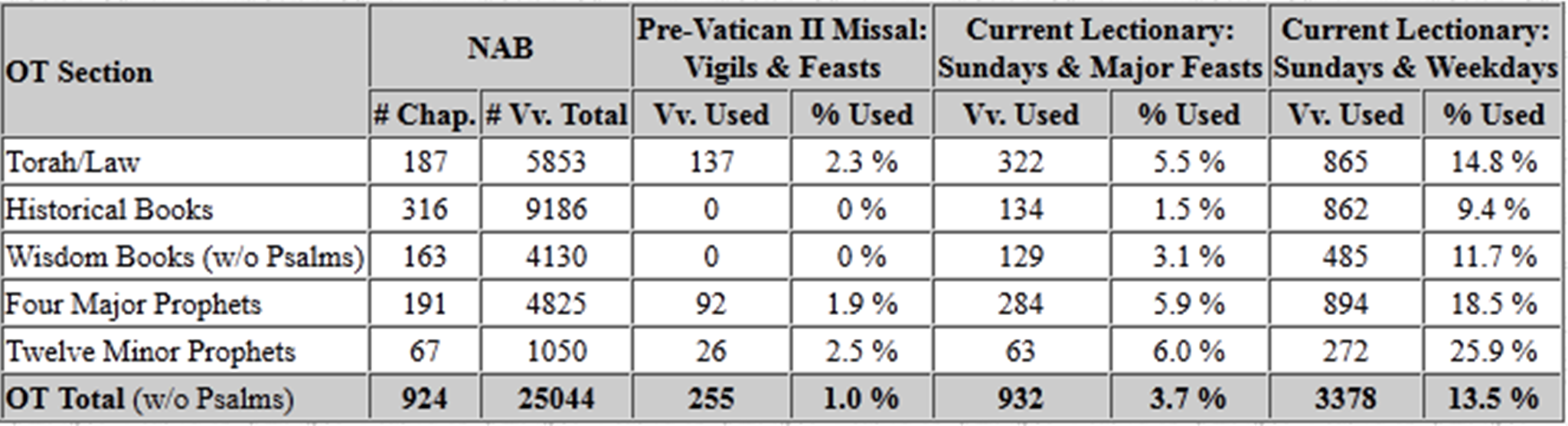
Fr. Felix Just, S J, PhD, has done extensive research on the Scripture readings used in the Missals both before and after Vatican II.  Here is his analysis:

OT Comparison Felix Just

At the time after Trent the Roman Missal excluded nearly all of the Old Testament.  And while that has improved post-Vatican II, today’s Roman Catholic is exposed to only 13.5% of the Old Testament (excluding what Psalms are sung responsively) when s/he attends Mass.  (How Rome can evade the charge of institutionalized Marcionism is worth pondering.)

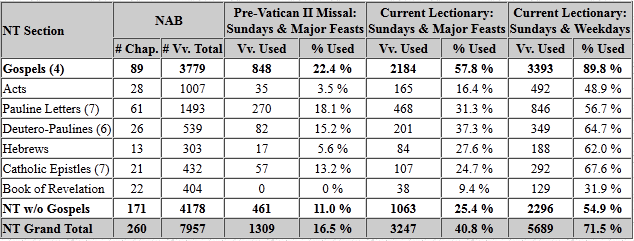
Here is Fr. Just’s analysis of the use of the New Testament:

Comparative Use of NT Texts in Roman Missal

(Source:  http://catholic-resources.org/Lectionary/Statistics.htm)

While the NT is certainly represented more fully than the OT, it is easy to see that today’s Roman Catholic still misses nearly 30% of it, if their only exposure is at the Mass.

Conclusion:

It is entirely unclear how the “Interpretive Paradigm” offered by C2C could have operated at all in the period between Trent and Vatican II.  And the reason for that is clear. As we have seen earlier, the Roman Church programmatically eliminated printed bibles from personal possession while it ceremonially eliminated 99% of the OT and 83% of the NT from its corporate worship.  How could any good Catholic have been expected to ask a question which might have been interpreted by the Magisterium when they had not the basic Scriptures about which to ask?

I am becoming more convinced as we go that this new “IP” from our friends at C2C is simply an anachronism.

Soli Deo Goria

How the Magisterium of the Roman Catholic Church Contradicts Called to Communion’s Interpretive Paradigm

18 Monday Feb 2013

Posted by Paul Bassett in Bryan Cross, C2C IP, Reformation, Roman Catholicism, Trent

≈ Leave a comment

The fellas over at Called to Communion (C2C) are behaving like young boys with a new bike.  And that new “bike” is what they describe as their “Interpretive Paradigm” (hereafter, IP).  Just as a shiny new bike makes a young lad feel superior to his friends – at least until the first scratch or dent – so the C2C crowd seems to feel around their new IP.  But the funny thing – it’s really not funny – is that this new IP actually contradicts the history of the Roman Catholic Church.  And in so doing puts C2C in a precarious position vis-à-vis their intention of shoring up belief in the Roman Communion.

What I will attempt here is to define this novel, new IP as described by C2C.  Then, in keeping with the theme of Reformation 500, I will apply this IP specifically to the Roman Catholic Church at the time of the Reformation.  What we will find is that not only did this IP not apply to Roman Catholics at that time, but the very subject matter intended to be scrutinized by the IP was systematically eradicated by Rome thereby making the IP worthless.  In other words, at the time of the Reformation the C2C paradigm would have had nothing to interpret.  We will also find that the IP used by the Roman Church in Italy was very different than that used by Roman Catholics in other parts of Europe which negates the very nature of the paradigm.

IP Defined

As nearly as I can tell, the C2C IP was born out of an analysis that Bryan Cross did with Neal Judisch on Keith Mathison’s book, “ The Shape of Sola Scriptura”.  You can read the whole thing here.  I believe an accurate reduction of the idea is this, in the words of the C2C authors:

The person becoming Catholic, by contrast, is seeking out the Church that Christ founded. He does this not by finding that group of persons who share his interpretation of Scripture. Rather, he locates in history those whom the Apostles appointed and authorized, observes what they say and do viz-a-viz the transmission of teaching and interpretive authority, traces that line of successive authorizations down through history to the present day to a living Magisterium, and then submits to what this present-day Magisterium is teaching. By finding the Magisterium, he finds something that has the divine authority to bind the conscience.

So there we have it.  The superiority of the Roman Catholic IP consists in the claim that,  1.) it can be located in history, 2.) it has divine authorization,  and 3.) it is consistent “through history”.  Fair enough.  C2C should be allowed to define its own terms and I hope I have been reasonable in my representation of them.

IP Tested

If we were to test this IP we would look for a laboratory that contained only those items needed by the IP but was free from any contaminants not needed by it.  And fortunately for us, history provides just such a laboratory – the Papal States.  The Papal States was a European country entirely under the control of the Roman church and its hierarchy.  It existed for 700 years until 1870 and was at its peak during the 16th century.  The Vatican exercised complete and total control over every aspect of life within those borders and therefore qualifies as the perfect laboratory to test the IP.  (And just to be clear, Bryan’s piece was in response to Dr. Mathison’s work on Scripture so we may confine our investigation thereto.)

Scripture in the Papal States

Implicit in the C2C IP is the availability of the Scriptures to every parishioner as is the case today.  That the Scriptures are available is the minimal requirement from which questions about Scripture can arise.  Today’s Roman Catholic has access to the Scriptures and to his/her priests and bishops in order to have their questions answered.  And that is what undergirds the C2C IP.  But such was not the case in the Papal States in the 16th century:

If an alert visitor from northern Europe tried to get to grips with the religious scene in Italy, one absence would be immediately obvious: there were no vernacular Bibles in the house of the laity.  Pope Paul V was perfectly serious when in 1606 he furiously confronted the Venetian ambassador with the rhetorical question ‘Do you not know that so much reading of Scripture ruins the Catholic religion?’[i]

I suppose that some may quibble over the phrase “so much reading of Scripture” but to the Supreme Pontiff of that day “so much” really meant “any”:

Bibles were publicly and ceremonially burned, like heretics; even literary versions of scriptural stories in drama or poetry were frowned on.  As a result, between 1567 and 1773, not a single edition of an Italian-language Bible was printed anywhere in the Italian peninsula.[ii]

It is worth a moment to pause and reflect at this point.  The boys at C2C want us to believe that the Magisterium of the Roman Catholic Church is the only God-given instrument whereby Scriptures can be properly and authentically interpreted.  And yet in a place and time where the Roman Catholic Church reigned supreme not only did they not exercise their alleged responsibility, but they used their temporal power to eliminate the Scripture to the greatest extent possible.  If the Pontiff thinks that reading the Scripture is the “ruin” of the Catholic religion, it is risible to maintain that he would stand as the head of an organization charged with giving “the divinely inspired interpretation” of that same Scripture.  Unless, of course, that “divinely inspired interpretation” is the burning of the Bible!

Scripture in the rest of Europe

The second nail in the coffin of the C2C IP for the period under investigation is that there was no uniformity of doctrine within the Roman Catholic Church in Europe.  For those Catholics who lived in northern Europe and had to interact with biblically literate Protestants, the Roman doctrine would have meant ecclesial suicide:

Even a visitor from the Catholic parts of Germany would find this astonishing: there a ban on Bibles would have been highly dangerous to a Church constantly confronting biblically literate Protestants[iii].

And one wouldn’t have to go as far as Germany.  The Republic of Venice vigorously maintained an independent stance from Rome.  The Catholic Church of Venice was outspoken against the reforms of the Council of Trent, which obviously included the Roman version of the canon of Scripture.

Reflect with me for a moment.  In northern Europe the availability of and familiarity with the Scriptures was necessary to the continued existence of Roman Catholicism.  But where the Magisterium was most powerful, Scriptures were the “ruin” of the Catholic religion and no Bibles in the vernacular were printed for over 200 years!  How could it even be possible for a Roman Catholic parishioner to avail himself of this marvelous IP when he would not have access to the very thing about which question might have been asked?  That is very troubling, indeed.

In Conclusion

The IP being promoted by the C2C crowd fails all of its own criteria.  The first of which is historicity.  Our examination has shown that the Popes of the Papal States in Europe had not the slightest interest in interpreting the Scriptures.  The historical record is clear that Pope Paul V especially, was committed to the eradication of Scripture from his domain.  The claim that Rome or its Magisterium would have exercised any interpretive authority is null and void.

The second criteria placed on the C2C IP is its alleged divine authorization.  That claim cannot be supported by virtue of the fact that Rome was engaged in the destruction and eradication of the Scriptures which have been central to the Judeo Christian heritage for 3,000.  Further, the “divine” nature of the paradigm is called into question because it was not used in the majority of Roman Catholic churches throughout Europe.  Neither the Catholic churches in Venice , nor the Catholic churches in northern Europe nor the Catholic churches in Spain would have granted a divine aspect to anything Rome did.

And lastly, the obvious fact that the C2C IP differs so radically from the historical record of the Roman Catholic church negates the third attribute claimed for it.

We must necessarily conclude therefore, that the Interpretive Paradigm offered us by Bryan Cross and the folks at Called to Communion is an anachronism.  And an historical investigation shows that the IP fails to display any of the three criteria which its authors claim for it and is therefore to be disregarded.

Soli Deo Gloria


[i] MacCulloch, Diarmaid. The Reformation.  New York: Penguin Books, 2003.  P. 406

[ii] MacCulloch, Diarmaid. Op. cit.. P. 406

[iii] MacCulloch, Diarmaid. Op. cit.. P. 406

← Older posts
Newer posts →

Goodreads

Recent Posts

  • A General Theory about the 2020 Election Fraud July 9, 2021
  • Why the Roman Catholic Church MUST canonize Donald Trump June 16, 2018
  • What Everyone Needs to Know about the Paris Climate Accords June 14, 2017
  • Greg Bahnsen – an homage December 11, 2015
  • Pittsburgh, PA Mayor Peduto: Bring us Syrian Muslims! November 11, 2015

Archives

  • July 2021
  • June 2018
  • June 2017
  • December 2015
  • November 2015
  • October 2015
  • September 2015
  • August 2015
  • July 2015
  • June 2015
  • May 2015
  • March 2015
  • September 2014
  • July 2014
  • June 2014
  • May 2014
  • April 2014
  • March 2014
  • February 2014
  • December 2013
  • October 2013
  • July 2013
  • June 2013
  • May 2013
  • April 2013
  • March 2013
  • February 2013
  • January 2013
  • December 2012

Categories

  • Abortion
  • Acts 17
  • America's Christian Heritage
  • Andrew McCarthy
  • Apologetics
  • Armnianism
  • Authority
  • Bryan Cross
  • C2C IP
  • Caste system
  • Catholicism
  • Charles Chaput
  • Christianity
  • Climate Change
  • Darryl Hart
  • David Wood
  • Edgardo Mortara
  • Elections
  • Eucharist
  • Founding Fathers
  • Freedom
  • Garry Wills
  • George Weigel
  • Greg Bahnsen
  • Hermeneutics
  • Islam
  • Jihad
  • Kidnapping
  • Matthew 16
  • Movie Reviews
  • Papacy
  • Paris Climate Accords
  • Pat Buchanan
  • Quran
  • Raymond Brown
  • Reformation
  • Religious Freedom
  • Roger Olson
  • Roman Catholicism
  • SCOTUS
  • Trent
  • U S Constitution
  • Uncategorized
  • Unity
  • William Donohue

Meta

  • Create account
  • Log in
  • Entries feed
  • Comments feed
  • WordPress.com

Blogs I Follow

  • anactofmind
  • Roger E. Olson
  • The Gospel Coalition
  • The Heidelblog
  • The Jagged Word
  • "In verbo veritatis" (2 Cor 6:7)
  • Old Life
  • Glass House
  • My Blog
  • Return to Rome
  • Mark D. Roberts
  • Called to Communion
  • Larry Hurtado's Blog
  • Societas Christiana (2.0)
  • John Calvin Quotes
  • The Lonely Pilgrim
  • Reformation500
  • Viewpoint
  • Beggars All: Reformation And Apologetics
  • WordPress.com News

Create a free website or blog at WordPress.com.

anactofmind

If there is anything in the world that can really be called a man's property, it is surely that which is the result of his mental activity. - Arthur Schopenhauer

Roger E. Olson

If there is anything in the world that can really be called a man's property, it is surely that which is the result of his mental activity. - Arthur Schopenhauer

The Gospel Coalition

If there is anything in the world that can really be called a man's property, it is surely that which is the result of his mental activity. - Arthur Schopenhauer

The Heidelblog

Recovering the Reformed Confession

The Jagged Word

Where the sacred & profane collide

"In verbo veritatis" (2 Cor 6:7)

Thoughts and writings of Fr. Joseph A. Komonchak

Old Life

If there is anything in the world that can really be called a man's property, it is surely that which is the result of his mental activity. - Arthur Schopenhauer

Glass House

My lies will get better

My Blog

If there is anything in the world that can really be called a man's property, it is surely that which is the result of his mental activity. - Arthur Schopenhauer

Return to Rome

If there is anything in the world that can really be called a man's property, it is surely that which is the result of his mental activity. - Arthur Schopenhauer

Mark D. Roberts

If there is anything in the world that can really be called a man's property, it is surely that which is the result of his mental activity. - Arthur Schopenhauer

Called to Communion

Reformation meets Rome

Larry Hurtado's Blog

Comments on the New Testament and Early Christianity (and related matters)

Societas Christiana (2.0)

If there is anything in the world that can really be called a man's property, it is surely that which is the result of his mental activity. - Arthur Schopenhauer

John Calvin Quotes

The Lonely Pilgrim

A Christian's Road Home to Rome and Journey Onward

Reformation500

Viewpoint

If there is anything in the world that can really be called a man's property, it is surely that which is the result of his mental activity. - Arthur Schopenhauer

Beggars All: Reformation And Apologetics

If there is anything in the world that can really be called a man's property, it is surely that which is the result of his mental activity. - Arthur Schopenhauer

WordPress.com News

The latest news on WordPress.com and the WordPress community.

Privacy & Cookies: This site uses cookies. By continuing to use this website, you agree to their use.
To find out more, including how to control cookies, see here: Cookie Policy
  • Subscribe Subscribed
    • anactofmind
    • Already have a WordPress.com account? Log in now.
    • anactofmind
    • Subscribe Subscribed
    • Sign up
    • Log in
    • Report this content
    • View site in Reader
    • Manage subscriptions
    • Collapse this bar
 

Loading Comments...