• About

anactofmind

~ If there is anything in the world that can really be called a man's property, it is surely that which is the result of his mental activity. – Arthur Schopenhauer

anactofmind

Tag Archives: Catholic church

A Book Review: “The Refashioning of Catholicism, 1450-1700: A Reassessment of the Counter Reformation”

03 Tuesday Feb 2026

Posted by Paul Bassett in Papacy, Reformation, Trent

≈ Leave a comment

Tags

bible, Catholic church, Catholicism, Christianity, faith, history, jesus, Reformation, Trent

Were the changes in the Roman Catholic Church during the time of the Council of Trent solely the result of the Protestant Reformation?

That is the question that Fr. Robert Bireley poses in his book, “The Refashioning of Catholicism, 1450-1700: A Reassessment of the Counter Reformation”, (The Catholic University of America Press, Washington, DC; 1999). Bireley believes that a positive answer to that question neglects other equally compelling forces, individually and in combination, that were at work on the Roman church. And he believes those forces were the rise and concentration of political power in the state; the population explosion; the expansion of Europe into Asia, Africa and America; the Renaissance and lastly, the Reformation. And he aptly covers this expansive material in less than two hundred pages.

There are several themes that I thought were particularly interesting. The first is the historic relationship between local bishop and the pope. At the beginning of the period under review, the local office of bishop was little more than an annuity to the person holding the office. Therefore, the office was subject to political appointment and the office holder need not even reside in the diocese over which he was appointed. Further, he might hold several such “benefices” simultaneously. The net pastoral effect was that the local Roman Catholic may never see his bishop. This secularization of the episcopacy made the office into a political football. If a pope was fearful that a certain secular ruler may call a church council against him, he would use the bishops as a bargaining chip. Conversely, if a political ruler, having jurisdiction over the bishops in his province needed to bargain with the pope of Rome, the bishops were a handy token. The net effect was that the pope of Rome diminished the proper influence of the bishop on his flock and helped to create a theological void.


The second theme of interest is that this vacuum thus created was filled by the rise of new religious orders – the Jesuits, Capuchins, Carmelites, etc. Indeed, these orders tended to provide competition to the local bishop who did not to receive any support from Rome for his local authority. But these Orders – especially the ones that came into existence during this period – were affected by what Bireley calls the “individualism of the Renaissance.” Said individualism caused these new groups to become cults of a single personality: the Jesuits – Ignatius of Loyola; the Ursulines – Angela Merici. The net of it was that the local congregation, cut off from Rome and likely divorced from their local bishop became clay in the hands of these religious orders that may very well spread differing messages. Fr. Bireley says it well: “Catholicism was hardly monolithic.”


The author’s treatment of the Council of Trent is likewise insightful.

One of the many issues that Trent sought to resolve was the relationship of bishop to pope. Because of the abuse of pluralism – the holding of several benefices by one absentee bishop – the council declared that the bishop must reside in his diocese ‘by divine appointment.” However, if the episcopacy was indeed divinely appointed, how could the pope have any jurisdiction over it at all? Was the Pope divine? So, in the end, the exact relationship went undefined despite the lampooning that Rome endured from the Protestants on exactly this issue.


What was particularly surprising was Bireley’s description of Rome’s variegated response to slavery. It wasn’t until 1542 that Rome outlawed the enslavement of American Indians. Bireley is the master of understatement when he writes, “This was not the case with black Africans…There were Catholic voices that protested against the African slave trade, but they were few and they were not loud.” (pgs. 162, 163). Bireley offers no reason for the racial dichotomy but one might reasonably be deduced. Charles V was not pleased with Rome’s interference into the affairs of his empire. France had been chiefly involved in the trade of African slaves and his Spanish interests in America were its chief beneficiaries. Therefore, Roman interference in Charles’s overseas adventures may have been deemed politically unwise.

But there may be an even deeper reason.

One of the shortcomings of Bireley’s book is its failure to mention Rome’s enslavement of the Jews in the Papal States during the period of his investigation. For Rome, therefore, to speak out too loudly against slavery would inevitably bring scrutiny into its own practices. And, as history has shown, that scrutiny will not be kind to Rome’s 700 year imprisonment of the Jews in the Papal States and elsewhere.


The only error that I found was this. Fr. Bireley attributes to Robert Bellarmine an interpretation of the Council of Trent that “Scripture was not to be interpreted against the general sense of the early Fathers of the Church.” (p. 194) Whether Bellarmine is wrong and accurately understood, or whether Bireley has got Bellarmine wrong will be a matter for further investigation. But the standard of Trent regarding the interpretation of Scripture is that it must be done according to the “unanimous consent of the Fathers”, not the general sense.

There is much more of interest in this book and I can recommend it to your reading. Fr. Bireley presents his case admirably and according a principle he describes early on: “…historical scholarship ought to pursue historical truth objectively…” (p. 5) and he does so admirably. If the study of the Reformation period is an interest of yours, this book should be on your shelves.
How Roman Authority Destroyed Confession

18 Thursday Jun 2015

Posted by Paul Bassett in Catholicism

≈ 23 Comments

Tags

Authority, Catholic church, Catholicism

crisis

As I continue this exploration of the nature and effects of Roman Catholic authority, it should be remembered that the very idea is sometimes an attraction to those outside of the Catholic church. Protestants who are poorly catechized on this topic find the bold claims of Rome to be a safe harbor in a world of change and conflict. But, as we saw in my previous essay, Rome cannot come clean with regard to the very locus of its own authority. And, worse still, the historical record makes clear that the contradictory nature of Rome’s claims along with its claims to consistency render any assertion to authority moot on Rome’s own grounds.

Now we turn to how the authority of Rome actually harms the church. We will look at how the exercise of authority by Rome has virtually elimiated one of its own sacraments. We begin with what used to be referred to as Confession, later the sacrament of Reconciliation.

Professor Leslie Woodcock Tentler of the Catholic University of America has done extensive primary research in the dioceses of the United States. One of her specialties is inquiry into the practice of sacramental confession in American Catholic parishes. Professor Tentler notes that at the turn of the twentieth century it was common practice for American Roman Catholics to “go to confession” annually. This changed in 1905 when the pope issued a decree that the faithful should receive communion as frequently as daily. Because Catholics have historically tied the reception of the Eucharist with a previous visit to the confessional, the number of confessions heard in American parishes blossomed.

The next momentous event with regard to this sacrament in the United States, at least, was the 1930 promulgaton of the encyclical, Casti Connubii, by Pope Pius XI. Here, the pope sought to address the matter of Christian marriage and what he perceived as the faithful’s ignorance of the matter. The growth in the frequency of confessions mentioned aboved provided a natural means by which to effect his new emphasis.

Why was Casti Connubii so important? Precisely because the pope’s anxieties were well placed: like their European brethren, American Catholics prior to 1930 heard relatively little about birth control, even in the confessional…. Casti Connubii signaled an end to the era of “good faith ignorance.” Confessors were suddenly expected to be proactive: to question married penitents who gave reason for suspicion (or, for a time in the Archdiocese of Chicago, simply because they were married) and to condemn the sin in unyielding terms when it was confessed. i

Professor Tentler notes that this had two deleterious effects on the faithful: it made the practice of going to confession “excruciatingly difficult” for those Catholics practicing contraception and it made devout Catholics into subversives so as to to get past the priest’s demand for a “firm purpose of amendment”.

It further had the consequence of distancing the priests from their local flocks. Only those priests who were well known for toeing the papal line would be tapped for advancement. And those who knowingly allowed for the exercise of a congregant’s conscience in the matter were ostracized.

However, the situation was to change in a few short years with the beginning of the Second Vatican Council.

Several cataclysms erupted the details of which are beyond the scope of this writing but they should be well know to Catholics. The first was the juxtaposition of raised hopes and a heavy handed encyclical. During the Council, the pope had established a committee of devout, lay Catholics to make recommendations on the Church’s practice. There was apparently great hope in the work of this group. However, they were unserriptiously co-opted by bishops and cardinals toward the end of their tenure and their work was made void with the proclamation of Humanae Vitae. Many Roman Catholics felt rightly betrayed by Roman authority.

The second convulsion that occurred simultaneously was the result of the more “pastoral” approach of this new council. There came to be what Professor Tentler calls “a personalist theology of marriage”. This meant that the everyday Catholic could engage her conscience when deciding whether or not to confess her use of contraception to her priest. Previously the confessor was to “enforce” the Church’s teaching but the times. The whipsaw effect of this now-the-priest-is-enforcer vs. now-he’s not simply drove the stake deeper into the heart of this “sacrament”.

There also was the matter, to educated Catholics at least, of how the rhythm method of contraception could be promoted by a church that for centuries had condemned the practice as a matter of grave sin.ii

The amalgamation of these factors and others showed Roman Catholics just how capricious their Magisterium was. Further, their exaggerated claims to constancy in teaching over time having been disproven by the very contradiction that the rhythm method had laid bare the false claims of Rome’s authority.

Professor Tentler, once again,

Church authority, our leaders seem to believe, is credible only if one can point to a history of changeless teaching. One must at all costs maintain the fiction, which everyone knows it to be, that the teaching church is never wrong.iii

Roman Catholic authority with respect to the very sacrament of confession has rendered itself irrelevant. And, “Irrelevant institutions, by definition, lack authority.”iv

Even though exact statistics are unavailable, some today think that as few as ten percent of Roman Catholics in the U.S. go to confession – and then only monthly.v

What we have seen in this brief expose, is that Rome’s authority, far from being a safe harbor of certainty in a world of change is a destructive force. In the matter under examination, we have seen how the contradictory teachings and the contradictory manner of applying those teachings has had the effect of nullifying a sacrament of the church.

What more needs to be said to dissuade those considering joining Rome?

Soli Deo Gloria

iTentler, Leslie Woodcock. “Souls and Bodies: The Birth Control Controversy and the Collapse of Confession” in The Crisis of Authority in Catholic Modernity. New York. Oxford University Press, Inc. 2011 Pages 293-316. Kindle eBook.

ii See John Noonan’s work on contraception where he gently describes this contradiction as “topsy turvy”.

iii Tentler, ibid. Kindle loc. 6621

iv Ibid. Kindle loc. 6633.

v http://www.slate.com/articles/life/faithbased/2005/11/the_sin_box.html

Are Protestants more Roman Catholic than Catholics?

13 Tuesday May 2014

Posted by Paul Bassett in Abortion, C2C IP, Darryl Hart

≈ Leave a comment

Tags

abortion, Catholic church, Catholics, Patricia Miller, Rome

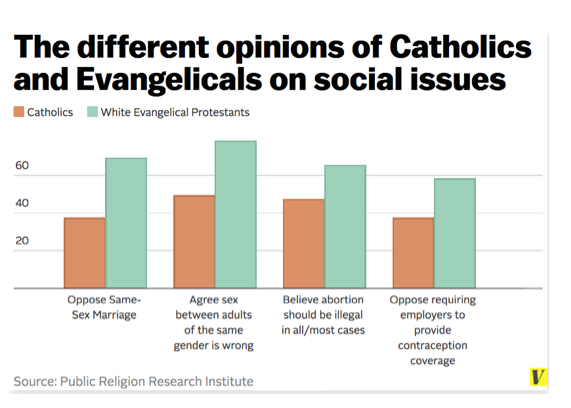
Catholic opinion survey vs Evangelical Protestants

Darryl Hart has picked up on an interesting work by Patricia Miller, here.  He notes how Catholics are leaving Rome for “another” Catholic church and how this exodus is being fueled by the great divide between Rome and (at least some of) her adherents.


The Catholic-Evangelical (Non-)Coalition | Religion Dispatches.

Goodreads

Recent Posts

  • A Book Review: “The Refashioning of Catholicism, 1450-1700: A Reassessment of the Counter Reformation” February 3, 2026
  • A General Theory about the 2020 Election Fraud July 9, 2021
  • Why the Roman Catholic Church MUST canonize Donald Trump June 16, 2018
  • What Everyone Needs to Know about the Paris Climate Accords June 14, 2017
  • Greg Bahnsen – an homage December 11, 2015

Archives

  • February 2026
  • July 2021
  • June 2018
  • June 2017
  • December 2015
  • November 2015
  • October 2015
  • September 2015
  • August 2015
  • July 2015
  • June 2015
  • May 2015
  • March 2015
  • September 2014
  • July 2014
  • June 2014
  • May 2014
  • April 2014
  • March 2014
  • February 2014
  • December 2013
  • October 2013
  • July 2013
  • June 2013
  • May 2013
  • April 2013
  • March 2013
  • February 2013
  • January 2013
  • December 2012

Categories

  • Abortion
  • Acts 17
  • America's Christian Heritage
  • Andrew McCarthy
  • Apologetics
  • Armnianism
  • Authority
  • Bryan Cross
  • C2C IP
  • Caste system
  • Catholicism
  • Charles Chaput
  • Christianity
  • Climate Change
  • Darryl Hart
  • David Wood
  • Edgardo Mortara
  • Elections
  • Eucharist
  • Founding Fathers
  • Freedom
  • Garry Wills
  • George Weigel
  • Greg Bahnsen
  • Hermeneutics
  • Islam
  • Jihad
  • Kidnapping
  • Matthew 16
  • Movie Reviews
  • Papacy
  • Paris Climate Accords
  • Pat Buchanan
  • Quran
  • Raymond Brown
  • Reformation
  • Religious Freedom
  • Roger Olson
  • Roman Catholicism
  • SCOTUS
  • Trent
  • U S Constitution
  • Uncategorized
  • Unity
  • William Donohue

Meta

  • Create account
  • Log in
  • Entries feed
  • Comments feed
  • WordPress.com

Blogs I Follow

  • anactofmind
  • Roger E. Olson
  • The Gospel Coalition
  • The Heidelblog
  • The Jagged Word
  • "In verbo veritatis" (2 Cor 6:7)
  • Old Life
  • Glass House
  • My Blog
  • Return to Rome
  • Mark D. Roberts
  • Called to Communion
  • Larry Hurtado's Blog
  • Societas Christiana (2.0)
  • John Calvin Quotes
  • The Lonely Pilgrim
  • Reformation500
  • Viewpoint
  • Beggars All: Reformation And Apologetics
  • WordPress.com News

Blog at WordPress.com.

anactofmind

If there is anything in the world that can really be called a man's property, it is surely that which is the result of his mental activity. - Arthur Schopenhauer

Roger E. Olson

If there is anything in the world that can really be called a man's property, it is surely that which is the result of his mental activity. - Arthur Schopenhauer

The Gospel Coalition

If there is anything in the world that can really be called a man's property, it is surely that which is the result of his mental activity. - Arthur Schopenhauer

The Heidelblog

Recovering the Reformed Confession

The Jagged Word

Where the sacred & profane collide

"In verbo veritatis" (2 Cor 6:7)

Thoughts and writings of Fr. Joseph A. Komonchak

Old Life

If there is anything in the world that can really be called a man's property, it is surely that which is the result of his mental activity. - Arthur Schopenhauer

Glass House

My lies will get better

My Blog

If there is anything in the world that can really be called a man's property, it is surely that which is the result of his mental activity. - Arthur Schopenhauer

Return to Rome

If there is anything in the world that can really be called a man's property, it is surely that which is the result of his mental activity. - Arthur Schopenhauer

Mark D. Roberts

If there is anything in the world that can really be called a man's property, it is surely that which is the result of his mental activity. - Arthur Schopenhauer

Called to Communion

Reformation meets Rome

Larry Hurtado's Blog

Comments on the New Testament and Early Christianity (and related matters)

Societas Christiana (2.0)

If there is anything in the world that can really be called a man's property, it is surely that which is the result of his mental activity. - Arthur Schopenhauer

John Calvin Quotes

The Lonely Pilgrim

A Christian's Road Home to Rome and Journey Onward

Reformation500

Viewpoint

If there is anything in the world that can really be called a man's property, it is surely that which is the result of his mental activity. - Arthur Schopenhauer

Beggars All: Reformation And Apologetics

If there is anything in the world that can really be called a man's property, it is surely that which is the result of his mental activity. - Arthur Schopenhauer

WordPress.com News

The latest news on WordPress.com and the WordPress community.

Privacy & Cookies: This site uses cookies. By continuing to use this website, you agree to their use.
To find out more, including how to control cookies, see here: Cookie Policy
  • Subscribe Subscribed
    • anactofmind
    • Already have a WordPress.com account? Log in now.
    • anactofmind
    • Subscribe Subscribed
    • Sign up
    • Log in
    • Report this content
    • View site in Reader
    • Manage subscriptions
    • Collapse this bar
 

Loading Comments...